I Live Here by Mia Kirshner, J.B. MacKinnon, Paul Shoebridge, and Michael Simons
– Reviewed by Angie Abdou for The Fernie Fix’s May 2009 Issue
Buy this book on Amazon.ca
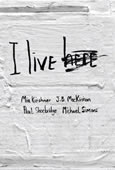 I might as well start by saying that I can’t do this book justice in a 500-word column. I Live Here is four books in one and contains contributions from many authors (including Canadian favourites such as Ann-Marie MacDonald, Lynn Coady, and Karen Connelly). It’s intriguing and praiseworthy on several levels: book as object, book as art, and book as political action. The inscription on the inside cover reads: “There are too many untold stories.” The four journals included inside I Live Here undertake the task of relaying some of those untellable narratives, and they do so in the form of journal entry, poetry, kiddy lit, comic strip, photograph, painting, collage, interview, and short fiction. Each beautifully designed journal focuses on one particular crisis: war in Chechnya, ethnic cleansing in Burma, globalization in Mexico, and AIDS in Malawi. I might as well start by saying that I can’t do this book justice in a 500-word column. I Live Here is four books in one and contains contributions from many authors (including Canadian favourites such as Ann-Marie MacDonald, Lynn Coady, and Karen Connelly). It’s intriguing and praiseworthy on several levels: book as object, book as art, and book as political action. The inscription on the inside cover reads: “There are too many untold stories.” The four journals included inside I Live Here undertake the task of relaying some of those untellable narratives, and they do so in the form of journal entry, poetry, kiddy lit, comic strip, photograph, painting, collage, interview, and short fiction. Each beautifully designed journal focuses on one particular crisis: war in Chechnya, ethnic cleansing in Burma, globalization in Mexico, and AIDS in Malawi.
Be prepared to be disturbed. I Live Here is not an easy read. It personalizes poverty, oppression, violence, and exploitation. The first paragraph talks about a young boy who may have been put in an oven or may have been shot in the head—violence that is nearly unimaginable in our safe haven of Fernie, BC. But Kirshner forces us to imagine it, right down to the details of the boy’s small hands and his smile that curls downwards. These are not the faceless oppressed that we hear about every day on the news; these are real, individualized people. We meet them in these pages, get to know them, and then feel them suffer. The introduction to the section on Chechnya asks: “So you walk into a refugee camp. What kind of person do you meet? Who is ‘a refugee camp’?” To subjugate a people, one must first turn those people into objects, mere things which deserve no better treatment. Here, Kirshner, in a series of stories, reminds us that a refugee is not an object but a multi-dimensional individual human being, a person whose suffering deserves our attention.
The next three books (or “chapters”) are equally powerful. The second one is based on two separate trips that Mia Kirshner and Michael Simons took to the Burma and the Thailand-Burma border area. This section includes conversational snippets from interviews with sex workers and Karen refugees. It is the starkness and brevity of these passages that I find haunting. It is the emotional flatness denoting utter despair that is most disturbing: “I can’t sleep, I can’t eat. I hear my heartbeat all the time. I can’t breathe, and I tremble.” Or, “I’m not afraid of anything, I don’t feel anything, I don’t have dreams, I don’t want anything.” What could make a person so empty? Do we want to know? This book doesn’t let us turn away, doesn’t allow us the luxury of oblivion. This is travel writing with a conscience.
I Live Here is nice to look at, nice to hold, very painful to read. The stories—in all the forms they take—aim to improve the world we live in by making each reader acutely and emotionally aware of what exactly is wrong with that world. That’s a lofty goal. Can a book really accomplish such political action? Can it really change the world by increasing empathy?
Read it and see.
* * *
–
Angie Abdou is a local writer who has two published books (Anything Boys Can Do and The Bone Cage) and two beautiful children (Oliver and Katherine).
|