Good to a Fault by Marina Endicott
– available at Polar Peek Books & Treasures in Fernie
– Reviewed by Angie Abdou for The Fernie Fix’s November 2009 Issue
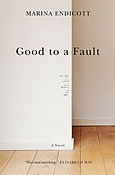 On facebook, I list my religious orientation as “Bibliotheist.” Partly, it’s tongue-in-cheek: I worship books. Partly it’s serious: where some people go to church to think about the way life ought to be lived, or to discover how to be a better person, or to think about where to place importance in daily life, I turn to great literature. Marina Endicott’s novel Good to a Fault is the kind of book that allows me space for such examination. In the tradition of Margaret Laurence, Alice Munro, Bonnie Burnard, Carol Shields, and Frances Itani, Marina Endicott makes great fiction out of ordinary women’s ordinary lives, but heightens the emotional and moral intensity so that we see ourselves and our choices not just reflected, but magnified. On facebook, I list my religious orientation as “Bibliotheist.” Partly, it’s tongue-in-cheek: I worship books. Partly it’s serious: where some people go to church to think about the way life ought to be lived, or to discover how to be a better person, or to think about where to place importance in daily life, I turn to great literature. Marina Endicott’s novel Good to a Fault is the kind of book that allows me space for such examination. In the tradition of Margaret Laurence, Alice Munro, Bonnie Burnard, Carol Shields, and Frances Itani, Marina Endicott makes great fiction out of ordinary women’s ordinary lives, but heightens the emotional and moral intensity so that we see ourselves and our choices not just reflected, but magnified.
In the novel’s opening scene, Clara, a forty-three year old insurance adjuster, crashes her car. Clara and the family in the other vehicle all escape serious injury. However, at the hospital, a doctor examines some unusual bruises on Lorraine, the mother of the family, and discovers that she has late-stage cancer. To complicate things, Clara learns that Lorraine’s family has been living in the now-smashed car. Overwhelmed by guilt, Clara takes Lorraine’s three kids (and her slightly batty mother-in-law) into her own home while Lorraine undergoes chemotherapy. Initially, Clara is defined primarily by her own remorse. She apologizes five times in the few pages following the accident. Why exactly is she so sorry? Is she sorry for causing the accident? Sorry for Lorraine’s bad luck with health? Sorry for her own class advantages over Lorraine’s family? This introductory chapter alerts the reader – Good to a Fault is a story about culpability, justified and unjustified. It’s also about the responsibility that comes along with such culpability. Because Clara accepts blame, she inherits the responsibility of a whole family. Does her acceptance of this responsibility make her “good”? Or is her goodness undermined by the fact that she grows to enjoy (even need) the children? Is her goodness lessened because her charitable act is, by necessity, very public? Endicott’s skillfully woven novel allows readers plenty of room to consider these ethical questions.
So, Clara is a middle-aged woman, previously accustomed to living on her own, but now caring for three very young children. This domestic emphasis means that Good to a Fault is a novel filled with grilled cheese sandwiches, baby Tylenol, and expensive grocery bills. There are “accidents” in the vegetable aisle, toys littering the living room, and brand new shirts stained with orange pop. Anyone who has ever parented can guess what other surprises Clara has in her new life: sleepless nights. Many, many sleepless nights.
Through the specific challenges Clara faces in her unexpected role as mother, Endicott explores the theme of motherhood in general. In fact, this text is jam-packed with mothers. There are surrogate mothers, birth mothers, foster mothers, absent mothers, and dead-but-still-very-present mothers. The novel led me to reconsider several of my own notions about motherhood, particularly in relation to issues of ownership, sacrifice, entitlement, mortality, pride, charity, perspective, and worthiness.
I don’t want to give the impression, though, that Good to a Fault is a heavy-handed moral tale. It’s not. Nor is it a novel in which the “issues” take precedence over the story. From baby Pearce to the loopy grandmother, Endicott has created family life in its entirety. Her distinct style creates an intimacy that allows us – even forces us – to love her characters in all their flawed reality. Endicott’s characterization and dialogue are so top-notch that you forget these are characters at all. Lorraine’s brood – and the misfit cast of adults attempting to care for them – quickly become so multidimensional and vivid that you’ll think you moved-in to Clara’s house too. You don’t just read this book – you live it.
–
Angie Abdou is now a Doctor (of Philosophy). Literary emergencies only, please. For more information on publications and upcoming speaking engagements, see this website.
|