The Small Mountain Community in Crisis: Downhill Slide by Hal Clifford
– Reviewed by Angie Abdou for The Fernie Fix’s May 2008 Issue
Buy this book from Amazon.ca
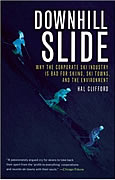 Though Hal Clifford’s Downhill Slide is not a new book, it stands out as the obvious choice for The Fix’s community issue. Clifford is an American freelance journalist who lives in Telluride, Colorado and has witnessed the effects that ski development can have on local community. His book condemns the development of publicly traded ski resorts, claiming that they ruin the defining characteristics of small mountain towns. In case a particularly obtuse reader might miss the gist of Clifford’s (completely unambiguous) argument, he has placed it in bold on the cover. The book’s subtitle—“Why the Corporate Ski Industry is Bad for Skiing, Ski Towns, and the Environment”—says it all. Though Hal Clifford’s Downhill Slide is not a new book, it stands out as the obvious choice for The Fix’s community issue. Clifford is an American freelance journalist who lives in Telluride, Colorado and has witnessed the effects that ski development can have on local community. His book condemns the development of publicly traded ski resorts, claiming that they ruin the defining characteristics of small mountain towns. In case a particularly obtuse reader might miss the gist of Clifford’s (completely unambiguous) argument, he has placed it in bold on the cover. The book’s subtitle—“Why the Corporate Ski Industry is Bad for Skiing, Ski Towns, and the Environment”—says it all.
Clifford’s romantic conception of the original North American ski town positions it as an alternate reality, a place where skiers could escape the petty greed and consumerism overtaking the rest of the world. He claims that it was a “nearly mythical region where people could reinvent themselves.” This romantic vein runs throughout his consideration of original ski-town dwellers, who he constructs as actively seeking an alternative lifestyle in a deliberate reaction against mainstream culture. “Long before the cultural rebellion of the 1960s,” he writes, “people actively exchanged the American mainstream for the countercultural joys of a winter sport that gave them an enormous sense of freedom and release.”
Of course, where ski bums are the halo-clad Good Guys of Clifford’s world, anyone involved in the development of skiing-as-tourism is an unredeemable, purely sinister Bad Guy. Clifford devotes 300 pages to his scathing condemnation of the relatively recent emergence of publicly traded ski corporations, and he claims that the threat of commercialization means that modern ski towns “are losing what it was that made them special in the first place, and so becoming more like the rest of America.” With the emergence of resorts, skiing becomes, according to Clifford, a “consumable experience,” and then “snow is a commodity, just like timber or oil or gas.” He contrasts early skiing towns (“real) with newer ski resorts (“fake”), arguing that “what is for sale […] is a lifestyle—something that is a marketing concept, a blow-up sex doll simulacrum of a life, not a way of life nor a life itself.”
This passage highlights what the book does well. It talks across disciplines—smoothly incorporating the usually mind-bending, postmodern concepts of Jean Baudrillard (author of Simulacra and Simulations) in a comprehensible fashion. Downhill Slide does the same with other disciplines—dabbling in philosophy, theology, economics, and environmental science—so that Clifford’s position comes across as intelligent, wide-ranging and eminently readable. Plus, it’s quite funny—especially if you’re on the right side of his jokes.
And that, of course, is the book’s short-coming—its complete one-sidedness. Clifford is so intent on making his own argument that he does not do justice to his opponents. Any introductory composition course will emphasize the importance of providing a fair consideration of oppositional arguments for the sake of complex and rigorous debate. It’s easy to take down the straw man of Development, but doing so does not lead to a productive conversation; instead it produces a polemical rant that preaches only to the converted.
Clifford’s conclusion complains that skiing corporations have “contributed significantly to the urbanization and gentrification of some of [North] America’s most magnificent places. They have displaced human communities and damaged natural ones. They have accelerated the on-mountain arms race and jacked up the cost of skiing, helping to force other ski areas out of business. They have made the sport increasingly unaffordable, drying up the pool of new skiers.” Toque-covered heads throughout North America will nod vigorously at these assertions. Unfortunately, any potential readers who didn’t already agree with Clifford would’ve dismissed the book as soon as they read the subtitle. In the end, Clifford comes down too hard on one side of the argument for his book to have any real-world impact. Livable solutions come in the form of compromise and are the result of discussions that give voice to multiple sides. Unfortunately, Clifford’s extremism does not encourage such discussions, and his argument will be ignored by those who most need to hear it.
* * *
– Angie Abdou is a Fernie writer. Her recent work includes a short-story collection called Anything Boys Can Do and a novel called The Bone Cage.
|